

FAQ
"Where sheep wool’s warmth meets equine care ."
💛 At Woolcare, we believe horses heal best when supported by natural materials that work with the body, not against it. Our Nordic sheep’s wool is carded but otherwise untreated, allowing it to retain its natural structure and lanolin. Rather than acting as a medical treatment, wool creates a breathable, protective environment where the skin can rest, regulate, and begin to recover naturally.
FAQ 1: How can wool help with mud fever, skin irritation, or swollen legs?
Wool works differently from many synthetic materials.
The secret ingredient in treating mud fever is lanolin and untreated wool.
- Wool helps keep the treated area dry.
- Lanolin naturally present in untreated wool supports skin recovery, helps scabs come off faster, and wool is naturally antibacterial.
- Many customers report visible improvements very quickly — often after just one use — because the skin is finally protected and no longer exposed to constant moisture.
- No additional creams or ointments are needed, as the wool already contains lanolin.
FAQ 2: What is lanolin, and why does it matter?
Lanolin is the natural grease found in sheep’s wool. It’s there to protect the sheep from cold, wind, and moisture — and it plays a similar role when used for horses.
Most wool products on the market are heavily washed and processed, removing lanolin completely. Our wool is different. It is left untreated, so the lanolin remains.
-
Most wool on the market has been washed and treated in a way that removes lanolin, meaning it no longer has the same skin-care benefits.
-
Lanolin is one of the key differentiators of our products and a major reason why customers often “see the difference after just one use.”
-
It makes the wool softer and more skin-friendly.
-
Untreated wool + lanolin is the true secret ingredient.
FAQ 3: Are the products suitable for all horses?
Yes. Wool products are suitable for all horses — foals, trotters, riding horses, leisure horses, and competition horses. Quite simply, all horses.
All horses can develop small wounds, skin issues, or leg problems where wool is an effective and gentle treatment method.
Competition horses benefit especially from wool’s ability to support fluid reduction and recovery, while trotters enjoy the soothing and relaxing effect of wool after a race.
Preventive care is important for every horse, and wool is a natural, safe choice for everyday use across all disciplines.
FAQ 4: Will wool make the leg too warm?
This is a very common concern.
Wool is warm in winter and cool in summer — it does not overheat the skin.
Wool breathes and manages moisture better than many synthetic materials.
-
Naturally breathable
-
Does not cause sweating
FAQ 5: Which product should I choose: VILLAge Wool Pads, Pastern Wraps, or Short Stable Boots?
Where will you use the boots — in the stable, trailer, or paddock?
Is the issue acute, such as mud fever or a tendon injury?
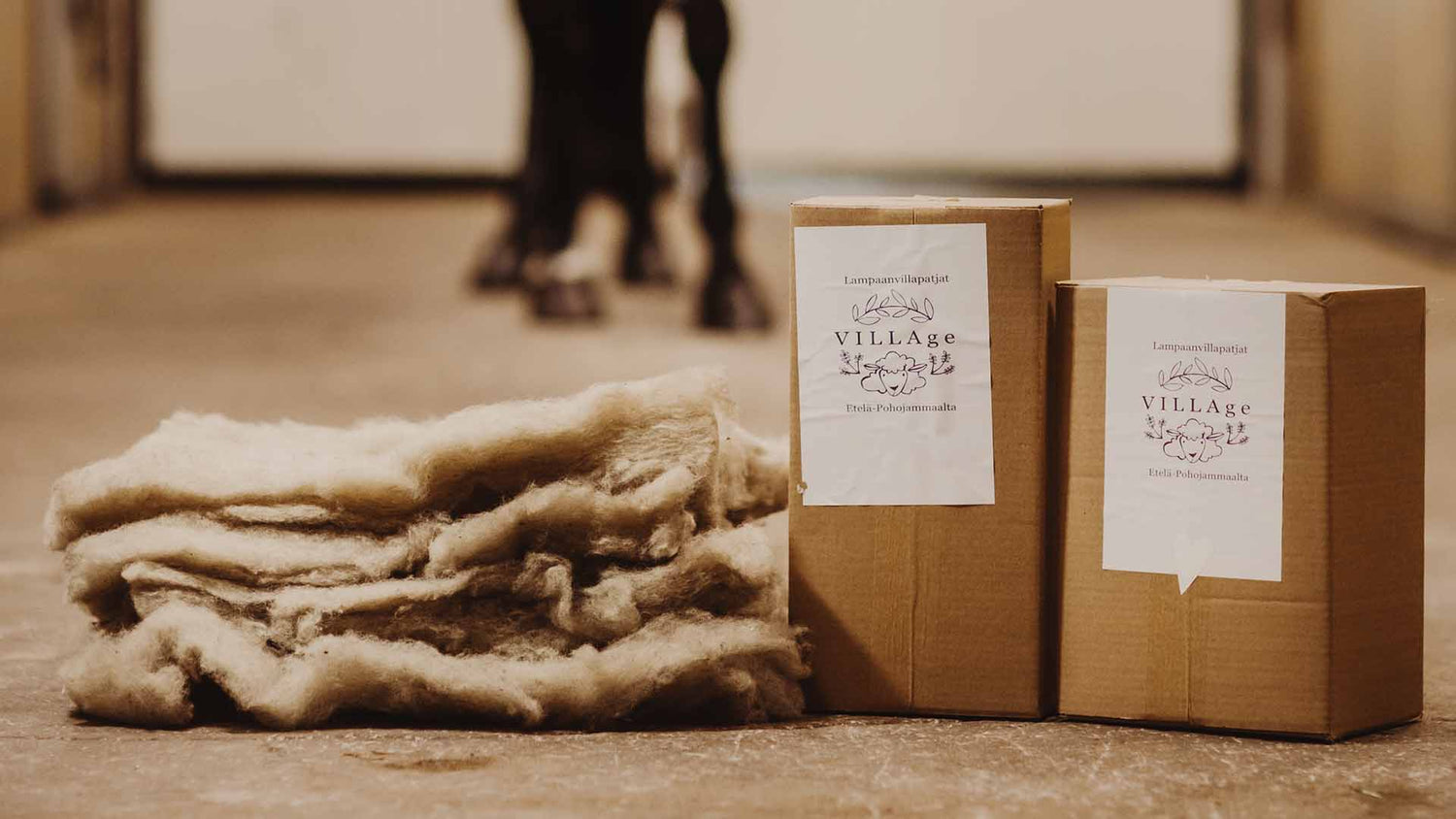
Wool pads (VILLAge):
For acute mud fever or acute tendon injuries. Best results when wrapped overnight. Can also be used in the trailer before training or competitions.
Pastern Wraps (Wooler):
A targeted product for mud fever. Best used once the worst phase has passed.
Short stable boots (Wooler):
An easy “all-in-one” solution. Best for recovery and overnight use.
If the issue is acute, choose wool pads to get the lanolin as close to the skin as possible.
FAQ 6: What size should I choose for my horse or pony?
Stable boots (short and long):
-
S: Large pony
-
M: Warmblood / half-blood
-
L: Finnhorse / large warmblood
Fetlock and hock boots:
-
S–M: Large pony
-
L–XL: Horse
You can always ask for help via chat, social media, or at elina@villagepatjat.fi
FAQ 7: How do I use the product for best results?
Because wool is a new care material for many, a clear routine helps:
-
Clean and dry the area (especially when treating mud fever).
-
Wool can be wrapped on a wet leg — it will simply felt faster.
-
Wrap the wool firmly around the leg with a bandage. Note that the wool compresses slightly.
-
Finnish sheep wool felts easily. After a few uses, the pad will look different than when new.
-
Do not stretch the wool, especially during the first few uses.
-
Wrap the wool completely under the bandage — do not leave it exposed.
-
Best results are achieved when used overnight, though shorter periods also help.
FAQ 8: How fast will I see results?
Wool is an effective treatment for equine leg issues.
Customer feedback commonly states that horse owners notice a difference after just one use — whether it’s mud fever or swelling.
In preventive use, when there is no active issue, changes are naturally less noticeable.
Wool pads generally help with mud fever. If they don’t, consult a veterinarian to check whether the issue could be something other than mud fever.
FAQ 9: How often do I need to reorder?
Many customers reorder approximately every two months to maintain the lanolin effect.
Especially when treating a specific condition, keep the wool fresh to provide the best possible support for your horse.
With each use, lanolin is absorbed into the horse and removed from the wool.
The same applies to Wooler products — order replacement wool once you feel the lanolin has diminished.
FAQ 10: How do I clean and care for the wool products?
Wooler products:
Remove the wool from the Wooler mesh after each use.
Wool pads:
Do not wash wool pads.
Used wool can be repurposed in the garden as mulch, under a saddle pad, or even as a seat warmer for a sulky.